

Aluminium vs uPVC Bi-fold Doors
If you are planning an extension, replacing old patio doors or supplying doors for a customer, the frame material is one of the first decisions you will need to make.
At first glance, aluminium and uPVC bi-fold doors appear to offer much the same thing. Both open up a room to the garden, require very little maintenance and come in a wide choice of colours. However, there are important differences in their appearance, cost and how well suited they are to larger openings.
What are bi-fold doors?
Bi-fold doors are made from connected panels that slide along a track and fold back against one another. They are popular because they create a wide opening often wall to wall, bring more daylight into the room and provide a better connection with the garden.
Aluminium and uPVC are the two most popular materials used for bi-fold door frames. In this guide, we compare their appearance, performance and cost to help you decide which is right for your project.
At a glance: key differences
| Feature | Aluminium bi-fold doors | uPVC bi-fold doors |
| Frame thickness and amount of glass | Slimmer frames and a larger glass area | Thicker frames and more visible framework |
| Suitable opening size | Particularly well suited to wide openings and larger door sets | Often chosen for smaller openings |
| Movement in hot and cold weather | Expands less as temperatures change | Expands more and may require more adjustment on larger sets |
| Finish | Durable powder-coated finish with a wide choice of colours | Coloured, foiled or sprayed finishes, depending on the system |
| Thermal Performance | Whole-door U-values from 1.6 W/m²K, depending on glazing and configuration | Varies according to the door system, glazing and configuration |
| Upfront cost | Higher | Lower |
| Best suited to | Extensions, wide openings and projects where slim frames are a priority | Smaller openings, matching uPVC windows and tighter budgets |
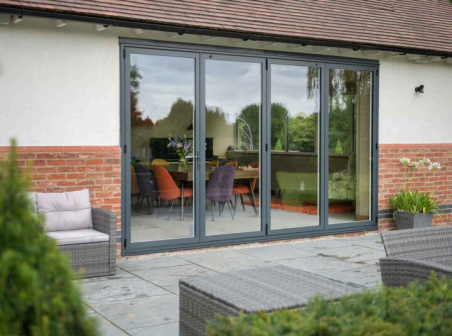
A closed aluminium bi-fold shows how much frame remains in the everyday view.
More glass, less frame
Aluminium is stronger than uPVC, which means the frames can be made slimmer without compromising the strength of the doors. On a three-panel bi-fold, you will start to notice the difference. Across five, six or seven panels, it becomes much more obvious. There is more glass, less frame and a clearer view into the garden.
uPVC frames need to be thicker, often with steel reinforcement inside. That may not matter on a smaller set of doors, particularly if you want them to match existing uPVC windows. Across a wide opening, however, the extra frame can make the doors look heavier and break up the view more than you might expect.
There is a difference in the finish too. Powder-coated aluminium has a clean, crisp appearance and is available in a wide range of colours, often with the option to choose different colours inside and out. uPVC still offers plenty of choice, but it cannot create quite the same slim look.
How well will they work over time?
The two materials respond differently as the temperature changes. uPVC expands and contracts more than aluminium, which can affect the alignment of a large set of doors over time.
A well-made and properly fitted uPVC bi-fold should still work perfectly well. However, aluminium is less prone to movement and better suited to supporting several large glazed panels. On a wider set of doors, that added stability can reduce strain on the hinges and help the panels remain properly aligned.
Both materials are relatively easy to look after. uPVC can be cleaned with warm soapy water, while powder-coated aluminium will not need painting. Whichever material you choose, keeping the track free from dirt and following the maintenance instructions will help the doors continue to open smoothly.
What about warmth and security?
It is easy to assume uPVC will be warmer than aluminium. Plastic is a natural insulator, while metal conducts heat. Modern aluminium doors get around this by placing an insulating section between the inside and outside of the frame. This is known as a thermal break, and it helps stop heat passing straight through the aluminium.
But the frame alone does not determine how warm the doors will be. The glass, seals and size of the complete door set all affect its thermal performance. This is measured by its U-value: the lower the number, the less heat escapes.
Our bi-fold doors achieve whole-door U-values from 1.6 W/m²K when specified with glass offering a centre-pane U-value of 1.0 W/m²K. The aluminium frames include wide polyamide thermal breaks and high-performance seals to reduce heat loss and draughts.
Security also depends on more than the frame. The locks, hinges, glazing and quality of the installation all play a part. Korniche bi-fold door frames are certified to PAS 24:2016 and come with multipoint locking, high-strength shoot bolts and a three-star Yale locking barrel as standard.

Door and shoot bolt handles are available in matching finishes.
Is aluminium worth paying more for?
Aluminium bi-fold doors generally cost more than uPVC. For a smaller opening, uPVC may be all you need, especially if it keeps the cost down and matches the rest of your windows.
The larger the opening becomes, however, the easier it is to see what the additional cost of aluminium gives you. Slimmer frames and wider panels create the wall of glass most people want from bi-fold doors, while aluminium’s greater stability makes it better suited to supporting a large set of panels.
The difference is visible every day, with more glass, slimmer-looking frames and a cleaner overall finish.
For a wider opening, a new extension or anywhere the doors will become a major feature, we would choose aluminium. That is also why we only supply aluminium bi-folds. For the types of openings our customers are creating, we believe they produce the better finished result.
So why Korniche?
Not all aluminium bi-folds are made in the same way. The frame material may be the same, but the panel sizes, hardware and fitting process can vary considerably between systems.
Our Korniche bi-folds are available with one to seven panels and can be made up to 6.4 metres wide, depending on the configuration. Individual panels can be up to 1.25 metres wide, so a large opening may need fewer panels. This means fewer vertical frames interrupting the view and more glass across the finished opening.
Korniche has also been designed with installation in mind. The doors arrive pre-assembled as standard, ready to be fixed into the prepared opening and glazed. The Speedbead system uses clip-in glazing beads with pre-fitted gaskets, making the glass quicker and less fiddly to fit than with a traditional wedge gasket.
Installers can download our bi-fold door installation guide before ordering or fitting the doors.

Korniche Speedbead uses a clip-in bead with a pre-fitted gasket. Image: Korniche.
This combination appeals to homeowners, builders and installers. Homeowners get the slim frames and clean finish they are paying for, while installers get a well-engineered system designed to make fitting more straightforward.
The opening will still need to be prepared correctly and the doors properly fitted and adjusted. But if you want more glass, less frame and an aluminium system that works for both the person buying it and the person fitting it, Korniche is a strong choice.
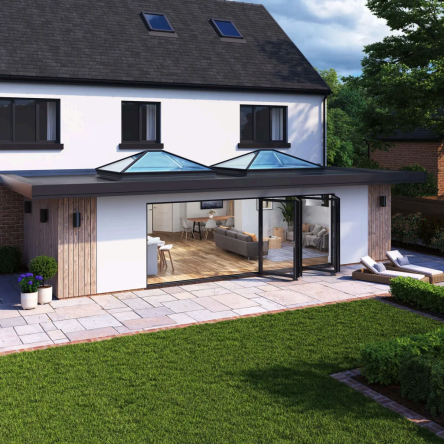
Korniche bi-fold doors fully open across a wide home extension. Image: Korniche.
You can design and price your made-to-measure Korniche aluminium bi-fold doors online. If you are unsure which panel arrangement will work best, speak to our team here at Windows Plus Doors before ordering and we will help you look at the options.